
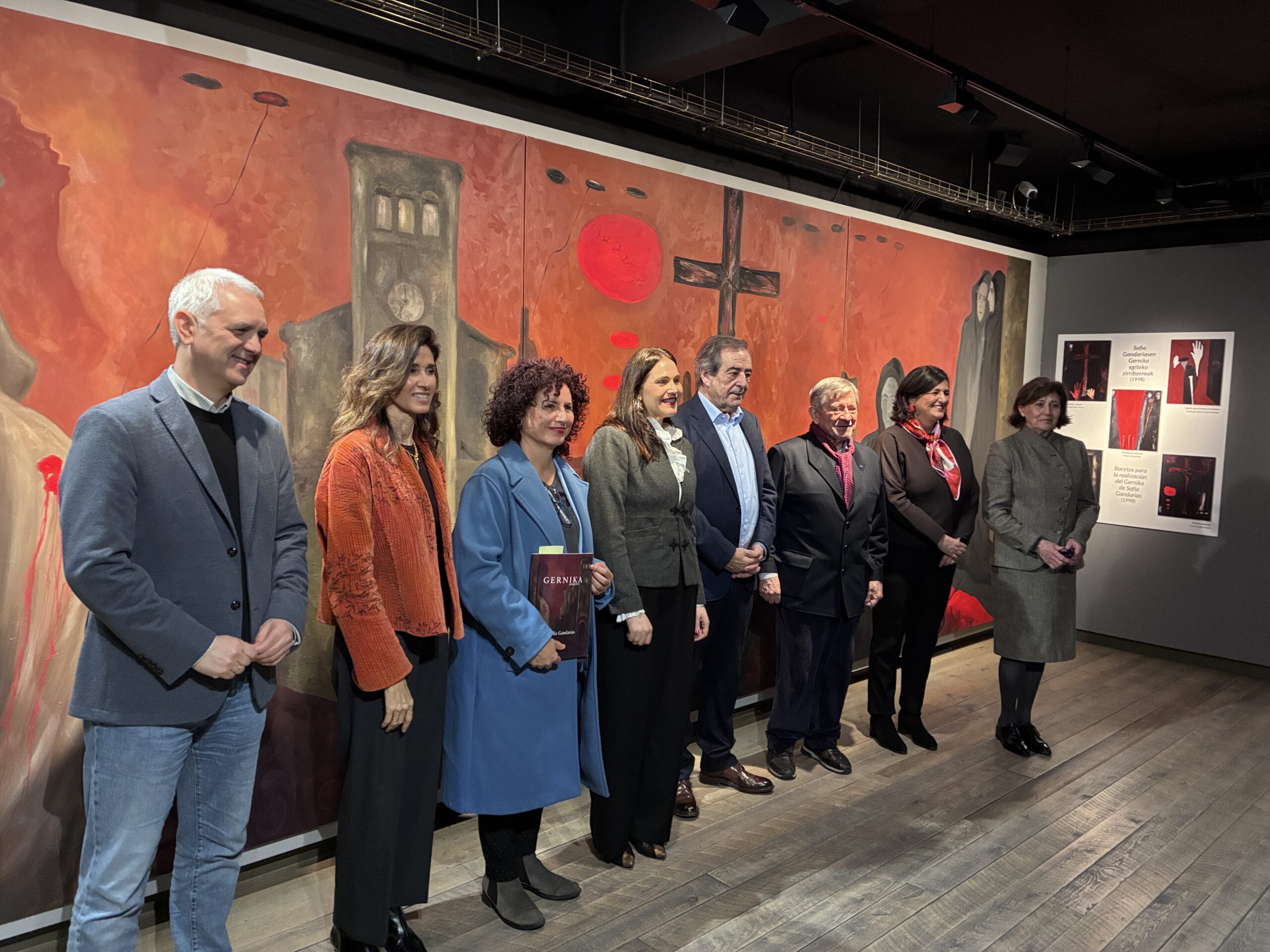
“Gernika peregrino” by Sofía Gandarias
I have always wanted to paint a triptych on Gernika, but the for a long time I felt unable to do so… Two years ago I realised the moment had finally come.
What I saw as a child growing up in Gernika in the sixties was a town built by the Agency for war—devastated regions. The victors of the Spanish Civil War had given us, the people of Gernika, a new town, something which called to mind Mussolini’s public works. It is those who win wars who write history. We, the vanquished, were left with our tree. The Gernika triptych is my own cry against something which should never happen again…
On 26th April 1937 the Condor Legion dropped heavy incendiary bombs on Gernika (the sacred city of the Basque people and the traditional symbol of their liberties) and blood rained down fiom the sky (in the centre of the painting), and gunned down the townspeople with the utmost brutality as they fled from the burning town (…)
It was a Monday, and market day. At 4:30 pm the church bells began to peal loudly. In Spain at that time the pealing of bells was an air-raid warning. A few minutes later a Heinkel 111 appeared, then another, then another. They dropped bombs and torpedoes, selecting their targets systematically.
In the first part of the triptych, these bombs kill “hope” (the pregnant woman), trace out a dance of death (the procession of the foetuses at the bottom of the painting) and destroy the Church of St John (the burnt down church). The church clock shows the time of the bombardment. What was left of Gemika? When the last plane flew away at 7:45 pm there were only old men, ashen-faced women and dead children (the last section of the triptych).
The Times of London correspondent, George L. Steer, wrote “when night fell, Gernika had ceased to exist”. It was thanks to Steer that the world learnt of the tragedy. I have acknowledged in a very concrete manner in the triptych the debt we all owe him. Suddenly Gernika was a turnace. A huge red stain enveloped the town (“and the sky rained blood”, or as Leon Felipe wrote “she stood alone and crucified, with Cain’s spear stuck in her side, alone and naked”).
The conception of his painting and its execution has involved a long, slow process of research, of steeping myself in our past. This has forced me to focus my eyes once more on the forgotten paths of childhood. It is a fact that painters carve out their paintings. I have arranged the triptych as though it were a partita. I came to painting through music and Verdi’s Requiem has been my travelling companion.
At this time my heart aches because of the death of Yehudi Menuhin. In Berlin, on a cold March morning. In the words of great Peruvian poet, Cesar Vallejo, “the black heralds” carried him away. Menuhin was to have conducted the Peace Concert in Gemika on the 26th April 2000. He who was the symbol of peace, was to have gone to the City of Peace, as a living example to all of tolerance, generosity, and humanity. Since his death, nothing feels the same for me.
I should like to dedicate these last words to the man who fought so hard for peace, and to say, echoing Benigni, that in spite of everything “la vita e bella”. Gernika has become a symbol of peace. The future is yet to be built. Let us build it together. We must all rise to the challenges laid upon us by destiny, and become standard-bearers for PEACE. In every place and in every situation. Even in the face of the anguish which events in Kosovo, so near our borders have caused us, our commitment must remain the same: nothing like 26th April 1937 ought ever to happen again.
Sofía Gandarias (Guernica 1951-Madrid 2016), fue formada en la Escuela Superior de Bellas Artes de San Fernando, recibió muchas condecoraciones, entre ellas la de Chevalier des Arts et des Lettres de la République Française y la de Chevalier de la Légion d’Honneur de la République Française. Ha realizado veinticinco exposiciones individuales y doce colectivas. Su obra está representada en importantes museos y colecciones públicas y privadas, tanto nacionales como internacionales, ninguna de sus exposiciones, y he presenciado varias de ellas, dejan al espectador impasible.
Su pintura se caracteriza por ser sobria, de colores quebrados y una técnica directa sin artificios, materializando un mundo interno, su mundo, sensible, culto y, sobre todo, cargado de compromiso social, altamente beligerante.
La pintura de Sofía Gandarias, crea llagas profundas en el espectador, remueve conciencias y carga de elemento simbólicos cada uno de sus cuadros, unas veces tratados de manera temáticamente individualizada y, otras, adoptando la fórmula de series temáticas de diversa intencionalidad denunciadora, crítica, o puramente satírica. Muchas veces se basa, antes de pintar, en textos de escritores importantes, que ella refleja en su pintura, plasmando la intencionalidad del autor.





zuzendaritza@bakearenmuseoagernika.eus


